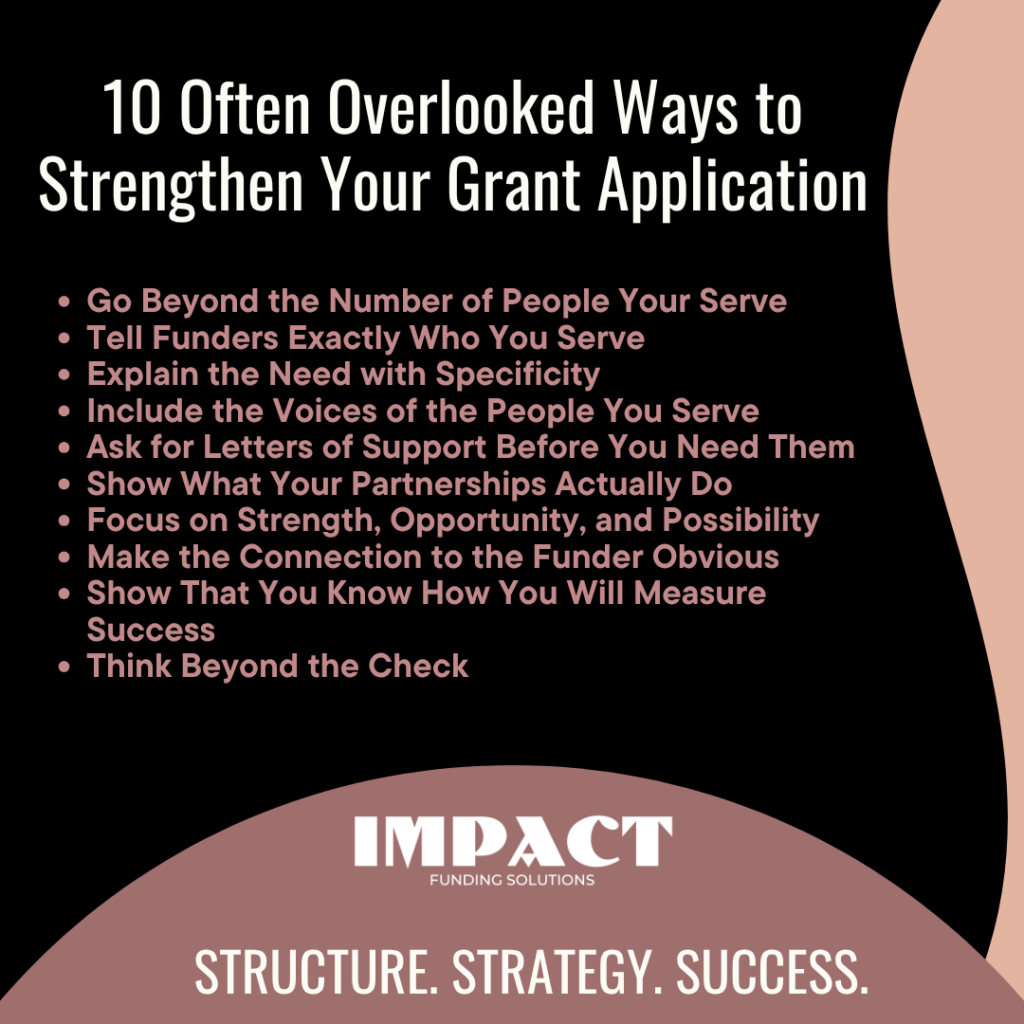
10 Often Overlooked Ways to Strengthen Your Grant Application
10 Often Overlooked Ways to Strengthen Your Grant Application
by: Jennifer Robertson, Grant Writer at Impact Funding Solutions
Grant applications can be competitive.
A funder may receive dozens or even hundreds of applications from nonprofit organizations doing meaningful work in their communities. While having a strong mission is important, a compelling mission alone does not necessarily make an application stand out.
One of the biggest lessons I have learned through grant writing is that the strongest applications give funders more than a description of programs and services. They provide evidence.
They help the reader understand who the organization serves, why the work is needed, what makes the organization credible, how the community is involved, and what difference funding will actually make.
Sometimes, relatively small additions can make an application significantly stronger.
Here are 10 ways nonprofits can strengthen their grant applications, including several that organizations often overlook.
1. Go Beyond the Number of People You Serve
One of the first questions I ask when preparing a grant application is: What numbers do we have?
Many organizations can tell you how many people they serve annually. That is important, but it is only the beginning.
Consider whether you can also provide:
- Number of individuals served through each program
- Number of families or households reached
- Number of programs, classes, events, or services provided
- Growth in participation from previous years
- Repeat participation or retention
- Number of volunteers involved
- Number of community partners
- Outcomes achieved by participants
- Current results compared with previous years or future goals
For example, saying that your organization served 500 people last year is helpful.
Saying that participation increased from 350 people to 500 people, representing approximately 43% growth, tells the funder something more. It demonstrates growing demand.
Numbers give funders a clearer picture of your organization’s reach, growth, and impact.
2. Tell Funders Exactly Who You Serve
Demographic information is often underused in grant applications.
Depending on your programs and the information your organization collects, this could include:
- Age ranges
- Income levels
- Geographic location
- Disability status
- Racial and ethnic demographics
- Gender
- Other populations relevant to your mission
You do not need to include every demographic available in every application. Focus on information that helps demonstrate the population you serve and its connection to the funding opportunity.
Geographic information can be especially valuable.
Instead of simply saying that you serve a county or state, consider whether you can identify specific cities, neighborhoods, counties, school districts, rural communities, or other geographic areas represented among participants.
This can become particularly important when applying to corporate funders or foundations that prioritize specific communities.
3. Explain the Need With Specificity
A strong statement of need should do more than explain that a problem exists.
It should help the funder understand why the people you serve need your particular services.
Think about questions such as:
What barriers does your community experience?
What happens when these services are unavailable?
Are there financial, transportation, accessibility, cultural, geographic, or social barriers?
Are there waiting lists or increasing requests for services?
Has participation grown?
Are community organizations approaching you for assistance or partnership?
External statistics can help establish that a larger problem exists, but your own organizational experience can demonstrate how that problem is showing up in your community.
The more specific you can be, the easier it is for a funder to understand why your program is necessary.
4. Include the Voices of the People You Serve
Sometimes the strongest evidence of impact comes directly from the people experiencing it.
With appropriate permission, collect quotes and testimonials from:
- Program participants
- Parents
- Caregivers
- Families
- Volunteers
- Teachers
- Community partners
- Employers
- Other individuals involved with your organization
A short quote can communicate something that several paragraphs of program description cannot.
For example, an attendance number can show that someone participated in a program. A participant explaining that the program helped them find employment, develop confidence, make a friend, feel less isolated, or access a resource they could not previously obtain demonstrates what that participation actually meant.
Do not wait until you are completing a grant application to begin gathering testimonials. Make collecting stories and feedback part of your ongoing program documentation.
5. Ask for Letters of Support Before You Need Them
Letters of support can provide valuable third-party validation of your organization’s work.
Consider requesting letters from:
- Community partners
- Schools
- Municipalities
- Program collaborators
- Employers
- Healthcare or social service organizations
- Community leaders
- Other organizations familiar with your work
A strong letter should do more than say that your organization is wonderful.
Ideally, it should explain the writer’s relationship with your organization, what they have observed, how the partnership benefits the community, and why they believe your work is valuable.
Even when letters are not required, having several current letters available means you are prepared when an application allows supplemental documentation.
6. Show What Your Partnerships Actually Do
Many grant applications include a list of community partners.
But simply naming partners does not tell a funder very much.
Instead, explain what those relationships accomplish.
Does a partner:
- Provide referrals?
- Donate space?
- Provide volunteers?
- Offer professional expertise?
- Help recruit participants?
- Provide training?
- Share resources?
- Deliver programming with you?
- Help your organization reach communities that may otherwise be difficult to reach?
This transforms a list of names into evidence of community collaboration.
It also demonstrates that your organization is not operating in isolation. You are part of a larger network working together to address community needs.
When possible, formalize important relationships through letters of support, partnership agreements, or memorandums of understanding.
7. Focus on Strength, Opportunity, and Possibility
There is a difference between demonstrating need and making the people you serve sound helpless.
Grant applications absolutely need to communicate challenges. However, relying too heavily on sadness, crisis, or a “sob story” can unintentionally reduce individuals and communities to the problems they experience.
Instead, describe barriers honestly while also showing strengths, potential, dignity, and opportunity.
Rather than focusing exclusively on what people lack, explain what becomes possible when the right resources are available.
What skills can participants develop?
What opportunities become accessible?
What connections can be created?
What independence, confidence, safety, stability, or belonging can be strengthened?
Your application should communicate why funding is needed while respecting the people at the center of your mission.
8. Make the Connection to the Funder Obvious
Do not make the reviewer figure out why your organization fits the funding opportunity.
Tell them.
Before writing, research the funder’s:
- Mission
- Values
- Funding priorities
- Geographic focus
- Populations of interest
- Previous grants
- Community initiatives
- Corporate responsibility priorities, when applicable
Then identify the genuine points of connection.
If a company prioritizes workforce development and your program prepares individuals for employment, explain that alignment.
If a foundation emphasizes reducing social isolation and your programs intentionally create opportunities for community connection, make that connection clear.
This does not mean changing your mission to fit a grant.
It means helping the funder see where your existing work and their priorities naturally intersect.
9. Show That You Know How You Will Measure Success
Funders want to know what their investment will accomplish.
Do not limit your evaluation plan to statements such as “we will track attendance.”
Attendance tells you whether someone showed up. It does not necessarily tell you whether the program worked.
Depending on the program, consider tracking:
- Participation
- Retention
- Skills gained
- Employment outcomes
- Program completion
- Increased knowledge
- Access to resources
- Participant feedback
- Referrals
- Repeat engagement
- Progress toward clearly defined goals
Whenever possible, establish a baseline and a target.
Instead of simply saying you hope to increase participation, identify where participation currently stands and what you hope to achieve.
This gives the funder something concrete against which progress can eventually be measured.
10. Think Beyond the Check
This is an area that nonprofits sometimes overlook, particularly with corporate funders.
A potential funder may be able to contribute more than money.
Consider whether there are opportunities for the company’s employees or team members to:
- Volunteer at an event
- Participate in a service project
- Mentor program participants
- Share professional expertise
- Assist with a community initiative
- Attend an organizational event
- Participate in another meaningful way
When appropriate, mention these opportunities in your application or subsequent conversations.
And remember that funders are organizations doing mission-driven work too.
Acknowledge their investment in the community. Thank them for creating the funding opportunity. Demonstrate that you understand what they are trying to accomplish rather than treating them simply as a source of money.
The strongest funding relationships can become partnerships built around shared goals.
Do you need help with your GRANT WRITING STRATEGY? We help nonprofits maximize their grant funding opportunities – CONTACT US today for a FREE DISCOVERY CALL.
One More Tip: Build Your Grant Library Before You Need It
Although this list promised 10 tips, this one is worth adding.
Do not wait until a grant is due to start collecting the information that makes an application strong.
Maintain an organized library containing:
- Current impact statistics
- Program participation data
- Demographic information
- Geographic reach
- Participant testimonials
- Letters of support
- Partnership information
- Program budgets
- Organizational budgets
- Recent Financial Statements
- Recent 990 or Tax Return
- Evaluation results
- Leadership and staff biographies
- Photos, when appropriate
- Organizational policies and supporting documents
- Recent accomplishments and recognition
Update this information throughout the year.
When an opportunity with a short deadline appears, you will already have much of the evidence needed to prepare a competitive application.
