Are You Using Press Releases to Help Your Nonprofit Raise More Money?
Are You Using Press Releases to Help Your Nonprofit Raise More Money?
Nonprofits put an enormous amount of effort into fundraising. You plan the event, secure sponsors, build the donation or registration page, create graphics, schedule social media posts, email supporters, recruit volunteers, and spend weeks or even months preparing for the big launch. But there may be one important question missing from your fundraising marketing plan: Does the media know about it?
Recently, I was speaking with a nonprofit preparing to launch a major new fundraiser. We were talking about the campaign, how they planned to promote it, and how they could get more people excited about participating when I asked: “Is your marketing team sending out a press release?”
That conversation stuck with me because nonprofits can invest an incredible amount of time, money, and energy into creating a great fundraising campaign, only to promote it primarily to people who already know them. Your Facebook followers know you. Your email subscribers know you. Your existing donors and volunteers know you. But what about the thousands of potential supporters in your community who don’t know you yet?
This is where public relations and earned media can become another valuable piece of your nonprofit fundraising strategy. And despite the enormous changes we’ve seen in digital marketing, social media, and AI-powered search, press releases are far from dead. Cision’s 2025 State of the Media research found that 72% of journalists identified press releases as the most useful resource PR professionals can provide. Cision’s 2025 State of the Media research
So, if your nonprofit has something genuinely newsworthy happening, it might be time to start thinking beyond another Facebook post.
What Is a Nonprofit Press Release?
A nonprofit press release is an official, professional, concise, factual announcement created to share newsworthy information with journalists, editors, television and radio producers, community publications, and other media outlets. The important word here is newsworthy. A press release isn’t simply an advertisement asking a journalist to promote your fundraiser for free. Instead, you’re giving the media the information they need to determine whether there is a story their audience would find interesting, useful, inspiring, or important.
For a nonprofit, that story could be the launch of a significant fundraising campaign, an unusual fundraising event, an important new community program, a major grant or transformational gift, the opening of a new facility, a milestone anniversary, new research or community data, an urgent response to a local need, or an important partnership. The strongest nonprofit press releases don’t simply explain what the organization is doing. They explain why what the organization is doing matters to the community.
Consider the difference between “XYZ Nonprofit Announces Annual Fundraiser” and “Local Nonprofit Gives Away a New Car to Raise $100,000 for Families Facing Homelessness.” Both headlines could describe exactly the same fundraising campaign, but the second immediately gives a journalist, and their audience, a reason to pay attention. The fundraiser hasn’t changed. The story has.
How Can Press Releases Help Nonprofits Raise More Money?
There is an important distinction to make here. Sending a press release does not automatically increase donations.
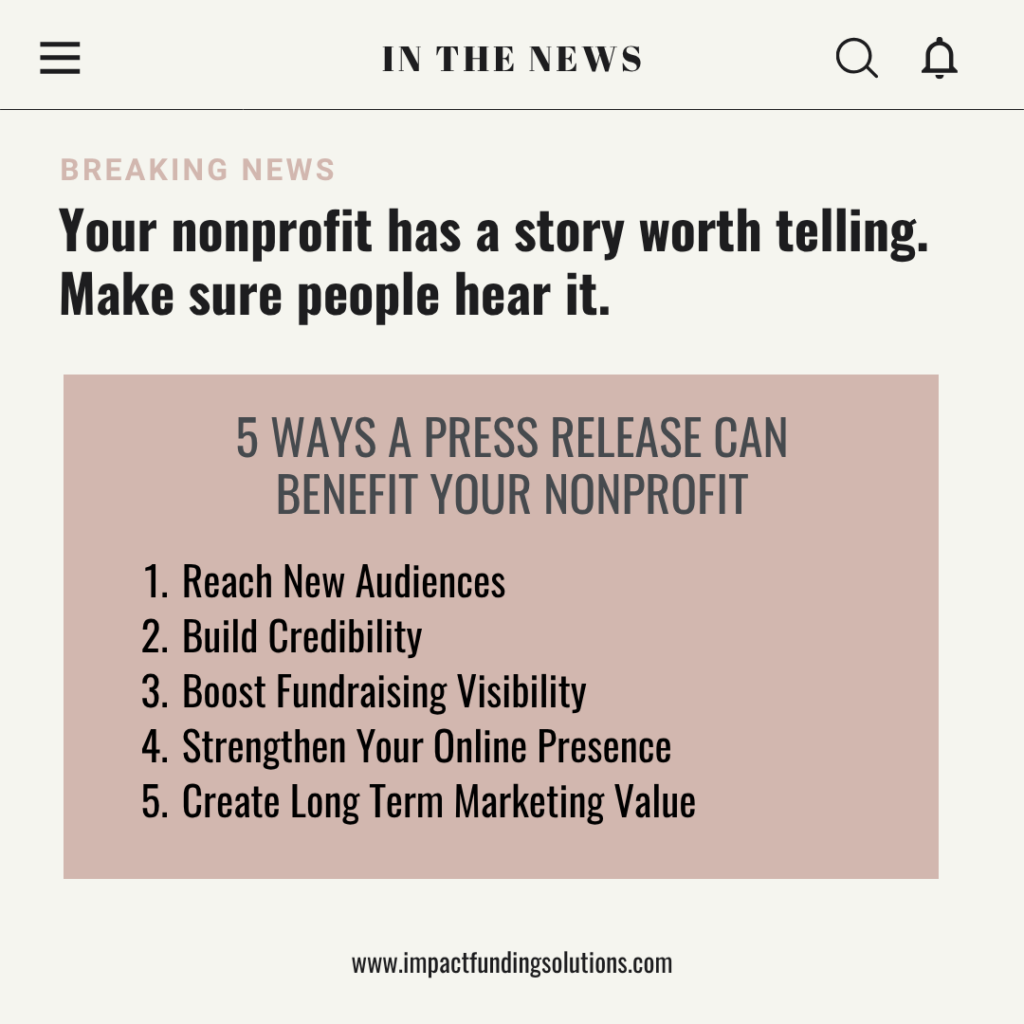
Instead, the potential fundraising benefit comes from the increased visibility that earned media can create. A well-written press release sent to the right journalist can potentially lead to a newspaper article, television segment, radio interview, online feature, podcast appearance, or other media coverage. That exposure can introduce your organization and your fundraising campaign to people who may never have encountered you through your existing marketing channels.
Imagine your nonprofit has 3,000 Facebook followers and 2,000 people on its email list. Those are valuable audiences, but you’re still communicating primarily within an existing circle. If a local television station, newspaper, radio station, or online publication tells your story to tens of thousands of people, you’ve suddenly expanded that circle considerably. Some of those people may participate in the fundraiser or make a donation. Others may visit your website, follow you on social media, volunteer, become a future donor, or tell someone else about your organization. A local business owner may even see the coverage and become interested in sponsorship.
There can also be a longer-term credibility benefit. A prospective donor researching your nonprofit may encounter the article months later. A corporate sponsor may Google your organization before responding to a sponsorship proposal. A foundation reviewing a grant application may look at your website and search your organization online as part of its due diligence. Credible third-party coverage gives people another opportunity to learn about your mission from a source other than your own marketing.
When Should a Nonprofit Send a Press Release?
Not everything your nonprofit does warrants a press release, and understanding that is an important part of developing a successful media strategy. Journalists aren’t looking for opportunities to provide nonprofits with free advertising. They’re looking for stories that will interest their readers, viewers, or listeners.
Before sending a press release, ask yourself a very simple question: Why would someone who has never heard of our nonprofit care about this?
A major fundraising campaign or unusual event can certainly qualify, but there are many other opportunities. Receiving a transformational grant, opening a new facility, launching an innovative program, reaching a significant milestone, announcing a major community partnership, responding to an urgent need, releasing meaningful research, or sharing an extraordinary impact story can all potentially create legitimate news value.
The key is finding the story inside the announcement. Your annual golf tournament may not automatically be newsworthy simply because it is happening again this year. But perhaps this year’s tournament will fund 10,000 meals for local families. Maybe a well-known community member is participating. Perhaps the organization is attempting to break a fundraising record, or the people benefiting from the campaign have a compelling story that illustrates a larger issue affecting the community.
Instead of asking, “How do we get the media to promote our fundraiser?” ask, “What is happening here that would make an interesting story for their audience?” That small shift in thinking can completely change the way you approach media outreach.
How Do Nonprofits Write a Press Release?
Writing a press release doesn’t require a public relations degree, but it does require you to think differently than you might when writing a fundraising email or social media post. A press release is written primarily for the media, so your goal is to make it as easy as possible for a journalist to quickly understand what is happening, why it matters, and whether there is a story worth pursuing.
Start with a strong, straightforward headline. A journalist scanning dozens of emails should be able to understand the story almost immediately. “Local Nonprofit Launches Annual Fundraiser” tells us very little. “Local Nonprofit Gives Away a Car to Raise $100,000 for Youth Mental Health Programs” tells us what is happening, why it matters, and gives us a reason to keep reading.
Your opening paragraph should cover the essential information: who, what, when, where, why, and, when appropriate, how. Don’t make a journalist read six paragraphs before discovering that your fundraiser is happening next Saturday. Lead with the news, then use the remainder of the release to provide context.
From there, explain why the fundraiser or announcement matters. How much are you hoping to raise? What will the money accomplish? Who will benefit? Is there a growing community need behind the campaign? This is an excellent place to include one or two strong statistics. For example, saying that you’re raising money for a food pantry is useful. Explaining that requests for emergency food assistance have increased 40% over the past year immediately provides context for why this fundraiser matters now.
Include a meaningful quote from your Executive Director, Board Chair, campaign organizer, community partner, or someone closely connected to the initiative. The quote should add emotion, perspective, or insight rather than simply repeat information already contained in the release.
You should also include the practical details someone needs to participate. If you’re promoting a fundraiser, provide the date, location, eligibility information, ticket or registration information, fundraising goal, and a clear way to learn more. At the end, include a short “About” section describing your nonprofit and clear media contact information.
Give the Media More Than Words
One of the easiest ways to strengthen your media outreach is to think visually. Have several high-quality photographs available.. Depending on the story, you might also have video footage, your logo, event graphics, photographs of your programs in action, or photographs of the people available for interviews.
If you can provide a compelling story, reliable information, an interview source, strong photographs, and everything needed to understand the campaign, you’ve removed several barriers between your pitch and potential coverage.
Courtesy of Impact Funding Solutions please find below a link to a FREE PRESS RELEASE TEMPLATE you can download to help you get started!

How Do You Get Media Coverage for a Fundraiser?
Writing the press release is only half the job. You also have to get it in front of the right people.
One of the biggest mistakes nonprofits make is creating a giant media list and sending the same generic email to everyone. Instead, spend some time researching the journalists and outlets most likely to care about your story.
Start locally. Look at newspapers, television stations, radio stations, community publications, business journals, local magazines, online news outlets, podcasts, and independent journalists. But don’t stop at the name of the publication. Find the individual journalists who regularly cover stories related to your organization.
If you’re an animal rescue, who covers pets or community stories? If you’re a youth organization, who covers education and families? If you’re raising money to build affordable housing, who covers housing, homelessness, development, or local government? If your fundraiser involves a local business partner, perhaps the business reporter is another potential contact.
Read what those journalists have actually written recently.
That small step can make a significant difference. Muck Rack’s 2026 media-pitching guidance emphasizes that successful pitches should align with the journalist’s beat, audience, and the actual news value of the story. Timeliness, impact, proximity, and human interest can all contribute to whether something is worth covering.
Don’t simply attach your press release to an email and write, “Please see attached.” Give the journalist a short, personalized reason to care. Mention the most interesting part of the story, explain why you thought it might fit their coverage, and let them know what you can provide.
Keep that introductory email relatively short. Muck Rack’s 2026 research found that 69% of journalists prefer pitches under 200 words. Your press release contains the details. Your email needs to get them interested enough to look at those details.
Think Beyond the Traditional Newspaper
Your media list in 2026 should probably look different than it did ten years ago. Local television and newspapers still matter, but there may also be community newsletters, online publications, radio programs, podcasts, industry publications, local bloggers, independent journalists, and other media creators covering your community or cause.
Think about where your potential donors actually get information.
If your organization serves a specific cultural community, perhaps there are publications or radio programs serving that audience. If your nonprofit works with veterans, there may be military and veteran-focused media. An arts organization may have local arts publications, calendars, critics, and cultural podcasts. An environmental nonprofit may find opportunities with outdoor publications or sustainability reporters.
The goal isn’t simply to get media coverage. The goal is to get relevant media coverage that reaches people who may care about your mission.
Follow Up, But Don’t Become a Pest
Journalists are busy, and silence doesn’t necessarily mean your story was rejected. Cision’s 2025 research found that one in two journalists surveyed received more than 50 pitches every week.
A polite follow-up can therefore be appropriate, particularly when you have a genuinely relevant story. Muck Rack’s 2026 discussions with journalists and communications professionals similarly recommend respectful follow-up when the story is strong and relevant.
What you don’t want to do is send five emails, call repeatedly, message them on three social platforms, and then ask why they haven’t covered you. Media relationships are relationships. Treat them that way.
If a journalist does cover your organization, thank them. Keep their contact information. Follow their work. And don’t make the next interaction you have with them another request.
Over time, your nonprofit can become a trusted source for stories related to your mission. A homeless shelter may eventually become a journalist’s source when they need perspective on local housing insecurity. An animal rescue may become the person they call when they’re reporting on overcrowded shelters. An arts organization may become a resource for stories about arts access or cultural programming.
That’s much more valuable than securing one article.
Don’t Let Your Media Coverage Disappear
This is one of my favorite strategies because it is incredibly simple and surprisingly underused.
Create an “In the Media” or “Newsroom” section on your nonprofit’s website.
Use this area to post your organization’s press releases so they remain accessible after you’ve distributed them. You can also include links to legitimate earned media coverage, such as newspaper articles, television interviews, radio appearances, podcasts, magazine features, and other stories featuring your organization.
This creates a central location where someone can see that your organization is active, relevant, and engaged in the community.
There can be visibility benefits as well. Your press releases become additional useful content on your website, and your media page gives visitors a structured place to learn more about your organization’s public presence. Just be thoughtful about copyright. Generally, link to the original article or media segment rather than copying and republishing someone else’s entire story on your website.
You can also reuse earned media through your other marketing channels. Share the article on social media. Include it in your email newsletter. Add an “As Seen In” section to an appropriate sponsorship package. Share significant coverage with your Board. Link to relevant media coverage from a campaign page when it adds credibility.
One piece of earned media can continue working for your nonprofit long after the original story was published.
PROTIP: You can use media coverage to strengthen grant applications by referring to articles and including an online link. Some grant applications actually ask for recent media links.
A Press Release Is Only One Part of the Strategy
A press release isn’t going to magically make your fundraiser successful. It also isn’t a replacement for email marketing, social media, sponsorship outreach, advertising, donor stewardship, your website, or your existing fundraising strategy.
But it can help you do something incredibly important:
Reach beyond the audience you already have.
If you’ve spent three months planning an incredible fundraiser, don’t limit the launch to an email blast and a handful of Facebook posts.
Ask whether there’s a bigger story.
Ask who might want to tell it.
Give them everything they need to tell it well.
And if you earn that coverage, don’t let it disappear after 24 hours. Put it on your website, share it with your supporters, include it in your newsletter, show it to potential sponsors, and build upon the credibility you’ve earned.
Because successful fundraising isn’t just about asking more people for money. It’s also about continually expanding the number of people who know who you are, understand why your work matters, and have a reason to become part of it.