
Maximizing Your Nonprofit Event: How to Secure Corporate Sponsorships
Maximizing Your Nonprofit Event: How to Secure Corporate Sponsorships Beyond Traditional Grants
Spring and summer mark peak event season for nonprofits across the country. From charity walks and runs to golf tournaments, galas, and community festivals, these months are filled with opportunities to engage supporters, raise funds, and build awareness for your mission. But if you’re only relying on individual ticket sales and participant registration fees, you’re missing out on one of the most significant revenue streams available: corporate event sponsorships.
Here’s something many nonprofit leaders don’t realize: those same corporations and foundations you’re approaching for grants often have separate budgets dedicated specifically to event sponsorships. In fact, during our grant research and writing work at Impact Funding Solutions, we frequently discover event sponsorship opportunities sitting right alongside traditional grant programs in the same funder portals and application systems.
The best part? Event sponsorships are easier to secure than traditional grants, offer more flexible funding, and provide benefits that extend far beyond a single check.
Understanding the Difference: Grants vs. Sponsorships
While grants and sponsorships both provide funding to nonprofits, they serve different purposes and come from different budget lines within corporations and foundations.
Traditional Grants:
- Focus on program or operating support
- Require detailed proposals about measurable outcomes
- Often have lengthy application processes
- Typically restricted to specific program activities
- Emphasize community impact and mission alignment
- May take months from application to approval
Event Sponsorships:
- Focus on visibility and brand association
- Provide marketing and recognition opportunities for the sponsor
- Often have simpler, streamlined application processes
- Usually unrestricted or loosely restricted funds
- Emphasize community engagement and corporate visibility
- Can often be secured in weeks rather than months
The key distinction? Grants support your programs; sponsorships support your events while giving the corporate sponsor valuable community visibility and marketing reach.
Why Corporations Love Event Sponsorships
Understanding what motivates corporate giving helps you position your event sponsorship requests more effectively. Companies invest in event sponsorships because they offer:
Brand Visibility: Logo placement on t-shirts, banners, websites, and promotional materials puts their name in front of your supporters—their potential customers.
Community Goodwill: Association with a charitable cause enhances their reputation and demonstrates corporate social responsibility.
Employee Engagement: Many companies encourage employee participation in sponsored events, boosting morale and team building.
Networking Opportunities: Events provide face-to-face interaction with community leaders, customers, and other businesses.
Marketing ROI: Compared to traditional advertising, event sponsorships often deliver better return on investment with built-in goodwill.
Measurable Impact: Unlike some grant programs, event sponsorships offer clear metrics: attendee numbers, impressions, social media reach.
Where to Find Corporate Sponsorship Opportunities
The good news is that if you’re already doing grant research, you’re likely sitting on a goldmine of sponsorship prospects you haven’t tapped into yet.
1. Review Your Grant Research
Go back through the corporations and foundations you’ve researched for grants. Many have separate sponsorship programs or marketing departments that handle event sponsorships differently from their foundation grant programs.
2. Check Corporate Giving Portals
When you log into platforms like Walmart Spark Good, Target’s giving portal, or other corporate foundation systems, look for tabs or sections labeled “sponsorships,” “community support,” or “marketing partnerships.” These opportunities often sit right next to grant applications but get overlooked.
3. Local Business Connections
Don’t overlook local and regional businesses:
- Banks and credit unions
- Healthcare systems and hospitals
- Auto dealerships
- Grocery store chains
- Real estate companies
- Insurance agencies
- Law firms and accounting practices
- Restaurants and hospitality businesses
4. Industry-Aligned Companies
If your nonprofit serves a specific population or cause, target companies in related industries. For example:
- Health-focused nonprofits → pharmaceutical companies, medical device manufacturers, health insurance providers
- Youth sports organizations → sporting goods retailers, athletic apparel brands
- Environmental causes → outdoor recreation companies, sustainable product manufacturers
- Arts organizations → art supply companies, creative software providers
5. Companies Already Connected to Your Organization
Start with businesses that already know you:
- Current donors
- Board members’ employers
- Volunteer employers
- Past event attendees
- Local businesses near your facility
- Companies that have previously donated in-kind items
Creating Compelling Sponsorship Packages
One of the biggest mistakes nonprofits make is asking for sponsorships without offering clear value in return. Think of sponsorships as a partnership, not a donation. Your sponsorship packages should answer the question: “What’s in it for the sponsor?”
Develop Tiered Sponsorship Levels
Create multiple sponsorship tiers to accommodate different budget levels and provide clear differentiation in benefits:
Title Sponsor ($10,000+)
- Event named after sponsor (e.g., “ABC Company 5K Run”)
- Exclusive category sponsorship
- Prime logo placement on all materials
- Speaking opportunity at event
- VIP table or premium seating
- Social media feature campaign
- Press release mention
- Year-round recognition on website
Platinum Sponsor ($5,000-$9,999)
- Large logo on event t-shirts
- Booth or display space at event
- Logo on banners and signage
- Recognition in all promotional emails
- Social media mentions
- Program book full-page ad
Gold Sponsor ($2,500-$4,999)
- Medium logo on select materials
- Logo on website event page
- Social media mentions
- Program book half-page ad
- Company name announced at event
Silver Sponsor ($1,000-$2,499)
- Small logo on select materials
- Recognition on website
- Program book quarter-page ad
- Company name in promotional materials
Bronze Sponsor ($500-$999)
- Name listed on website and signage
- Recognition in program
- Social media thank you post
Offer Non-Monetary Sponsorship Options
Don’t forget that in-kind sponsorships can be just as valuable:
- Water or snacks for participants
- T-shirts or race bibs
- Printing services for promotional materials
- Venue space
- Audio/visual equipment
- Photography services
- Catering for volunteer meals
- Gift bag items or prizes
Crafting Your Sponsorship Pitch
Unlike grant proposals, sponsorship requests should be concise, benefit-focused, and visually appealing.
Essential Elements of a Sponsorship Request:
- Strong Opening Lead with your event’s impact and reach, not your organization’s need. Example: “Join 500 community members on May 18th for our annual Walk for Wellness, the largest health awareness event in our region.”
- Event Overview
- Date, time, and location
- Expected attendance
- Event history and growth
- Target audience demographics
- Media coverage expectations
- Sponsorship Benefits Be specific about what sponsors receive at each level. Use concrete numbers:
- “Your logo will be seen by 800+ participants and spectators”
- “Our event hashtag reached 45,000 impressions last year”
- “Featured in email blasts to our 3,200-person mailing list”
- Community Impact Briefly explain how the event supports your mission and benefits the community. Keep this section short—remember, sponsors are motivated by visibility and association, not just charitable impact.
- Clear Call to Action Make it easy to say yes:
- Provide a contact person with phone and email
- Include a response deadline
- Offer to schedule a call to discuss customized packages
- Attach a sponsorship agreement or commitment form
Make It Visual
Your sponsorship pitch should look different from a grant proposal:
- Use color and your event branding
- Include photos from past events
- Create a one-page sponsorship overview with tier options
- Design it to be easily forwarded internally
- Make sure your logo and contact info are prominent
The Sponsorship Timeline: When to Start Asking
Timing matters significantly in securing event sponsorships.
6-9 Months Before Event (Ideal Timeline)
- Reach out to potential title sponsors and major sponsors
- Many corporations plan their community investment calendars annually
- Allows time for corporate approval processes and budget allocation
3-6 Months Before Event
- Target mid-tier sponsorships (Gold and Platinum levels)
- Follow up with companies that showed interest but didn’t commit yet
- This is still a strong timeframe for most corporate sponsors
1-3 Months Before Event
- Focus on Bronze and Silver sponsors
- Approach local businesses with shorter decision-making timelines
- Secure in-kind donations and smaller sponsorships
Less Than 1 Month Before Event
- Very difficult to secure new corporate sponsors
- Focus on last-minute in-kind donations
- Reach out to individual board members and supporters for personal sponsorships
Following Up: Turning Maybe Into Yes
Persistence (without being pushy) is key to securing sponsorships.
First Follow-Up (1 Week) Send a friendly email: “I wanted to make sure you received our sponsorship proposal for [Event Name]. Do you have any questions I can answer?”
Second Follow-Up (2 Weeks) Call if you have a direct contact. Email if not: “I know you’re busy, but I wanted to reach out one more time about our [Event Name] sponsorship opportunity. We’d love to have [Company Name] as a partner. Is this something you’d like to discuss?”
Third Follow-Up (3-4 Weeks) Final outreach with urgency: “We’re finalizing our event materials next week and would love to include [Company Name] as a sponsor. I have one [Silver/Gold] level spot remaining. Are you interested?”
If you still don’t hear back, move on. Keep them on your list for next year and try again with plenty of lead time.
Maximizing Sponsor Value Beyond the Check
Once you’ve secured sponsors, your work isn’t done. Maximizing their experience ensures they’ll sponsor again next year.
Before the Event:
- Send a welcome packet with event details and sponsor benefits
- Share their logo and description for promotional use
- Tag them in social media posts about the event
- Introduce them to other sponsors for networking
- Invite sponsor representatives to volunteer or participate
During the Event:
- Give sponsors prominent, visible placement
- Thank them publicly during announcements
- Take photos of their signage, booth, or representatives
- Encourage attendees to visit sponsor booths or displays
- Provide VIP treatment if promised
After the Event:
- Send thank-you notes within one week
- Provide a sponsorship impact report with:
- Final attendance numbers
- Photos of their logo placement
- Social media metrics and reach
- Media coverage clips
- Testimonials from participants
- Total funds raised and community impact
- Share sponsor feedback survey
- Begin cultivating for next year’s event
Integrating Sponsorships Into Your Overall Funding Strategy
Event sponsorships shouldn’t exist in isolation from your grant strategy—they should complement it.
Strategic Integration:
- Use event sponsorships to introduce companies to your mission
- Leverage sponsorship relationships to open doors for grant conversations
- Include event sponsors in your donor stewardship communications
- Consider whether a sponsor might also be a good grant prospect
- Use event success stories in future grant applications
Remember, a company that sponsors your 5K run might also have a foundation that provides program grants. The sponsorship gives you a foot in the door and demonstrates their interest in your cause.
Sample Sponsorship Request Email
Here’s a template to get you started:
Subject: Partnership Opportunity: [Event Name] on [Date]
Dear [Contact Name],
I hope this email finds you well. I’m reaching out on behalf of [Your Organization] to share an exciting partnership opportunity with [Company Name].
On [Date], we’re hosting our [X Annual Event Name], which brings together [number] community members to support [brief mission statement]. Last year, we [impressive metric: raised $XX, served XX families, attracted XX participants], and we’re expecting even greater impact this year.
We’d love to have [Company Name] join us as a sponsor. I’ve attached our sponsorship package which outlines several partnership levels and the visibility benefits for each. Our sponsors receive prominent recognition before, during, and after the event, including [mention 2-3 top benefits].
I believe this event aligns beautifully with [Company Name]’s commitment to [something specific about their corporate values or community involvement]. I’d welcome the opportunity to discuss how we can customize a sponsorship package that meets your marketing and community engagement goals.
Are you available for a brief call next week to explore this opportunity? I’m happy to work around your schedule.
Thank you for considering this partnership. I look forward to hearing from you.
Warm regards,
[Your Name] [Title] [Phone] [Email]
Final Thoughts
Event sponsorships represent a significant untapped funding source for many nonprofits. While you’re putting time and energy into researching and writing grants, don’t overlook the sponsorship opportunities that may be sitting in those same corporate giving portals.
The beauty of event sponsorships is that they benefit everyone: your nonprofit receives crucial funding, your sponsors gain valuable community visibility, and your event becomes more successful and impactful. It’s truly a win-win-win scenario.
As you plan your spring and summer events, make sponsorship cultivation a priority from the very beginning, not an afterthought. Build sponsorship solicitation into your event timeline just as you would venue booking and volunteer recruitment. Treat sponsors as partners in your mission, deliver exceptional value, and watch as one-time supporters become long-term champions of your work.
And here’s a final insider tip from our work in grant research: when you’re exploring a corporation’s funding opportunities, always check for multiple pathways to support. That company might have a foundation grant program, a local store giving program, AND a corporate sponsorship budget—all accessible through different departments or applications. Don’t leave money on the table by only pursuing one avenue.
Ready to develop a comprehensive funding strategy that includes both grants and sponsorships? Impact Funding Solutions can help you identify corporate partners, craft compelling sponsorship packages, and build relationships that provide sustainable support for your events and programs. Contact us to learn more about our fundraising consulting services.
10 U.S. Companies Offering Event Sponsorships AND Grants
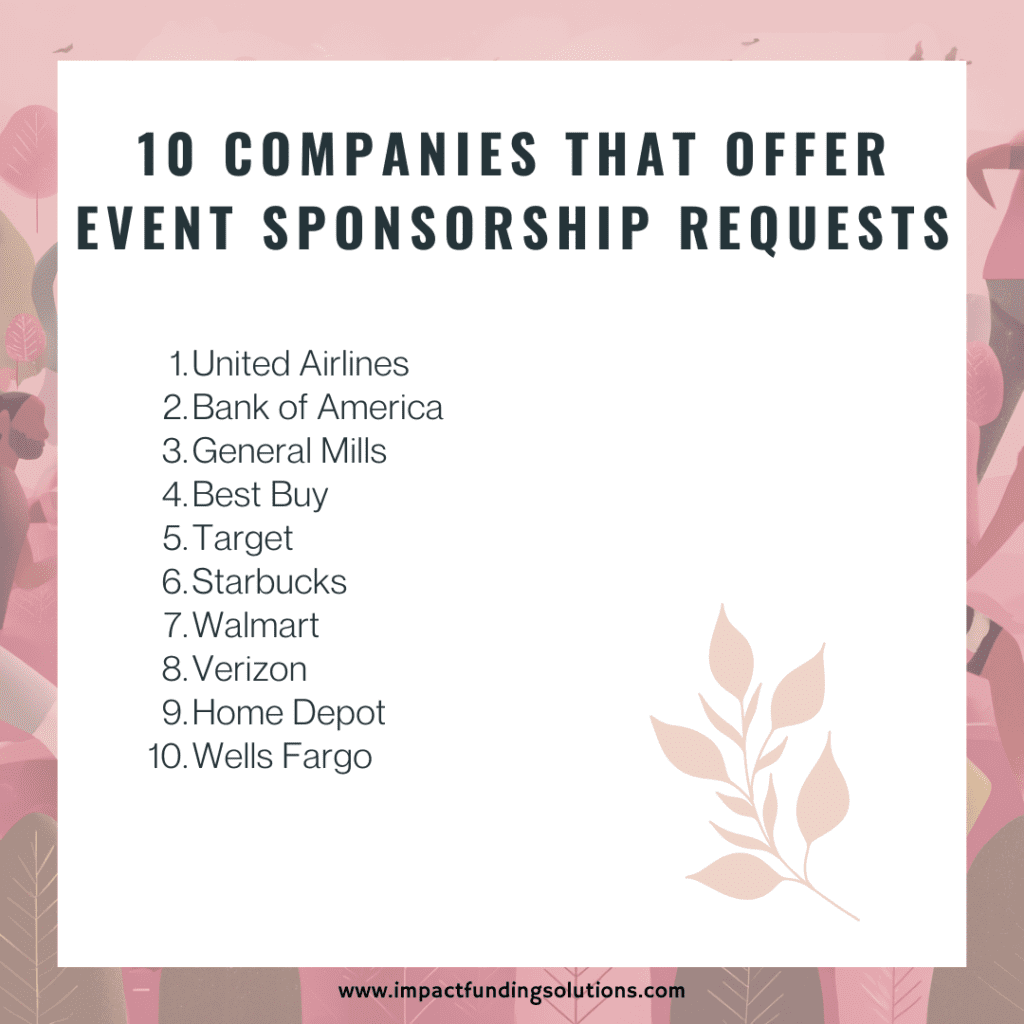
1. Best Buy
Focus: Youth technology access, STEM, digital equity
Support Types: Grants, community partnerships, event sponsorships
The Best Buy Foundation supports nonprofits that provide technology access and career readiness for youth. They also partner with organizations through sponsorships and community events.
🔗 https://www.bestbuyfoundation.org/grants
2. Walmart
Focus: Community needs, hunger relief, workforce development
Support Types: Local grants, event sponsorships, in-kind donations
Walmart offers Spark Good Local Grants through local stores and frequently supports community events and nonprofit fundraisers through store-level sponsorships.
🔗 https://walmart.org/how-we-give/local-community-grants
3. Bank of America
Focus: Economic mobility, housing, workforce development
Support Types: Corporate sponsorships, foundation grants
Bank of America provides both charitable grants and extensive arts, sports, and community event sponsorships through regional programs.
🔗 https://about.bankofamerica.com/en/making-an-impact/grants-and-sponsorships
4. Target
Focus: Education, youth development, community vitality
Support Types: Grants, local event sponsorships, product donations
Target gives millions annually through grants and community partnerships and frequently sponsors school and community events through local stores.
🔗 https://corporate.target.com/sustainability-governance/community
5. The Home Depot
Focus: Housing, veterans, community revitalization
Support Types: Foundation grants, event sponsorships, volunteer support
The Home Depot Foundation funds housing and community projects and often supports nonprofit initiatives and events aligned with its mission.
🔗 https://corporate.homedepot.com/page/community
6. Wells Fargo
Focus: Financial health, housing affordability, economic opportunity
Support Types: Corporate sponsorships, grants, community funding
Wells Fargo supports nonprofit programs and community events through corporate sponsorships and foundation grants.
🔗 https://www.wellsfargo.com/about/corporate-responsibility/community-giving/
7. Verizon
Focus: Digital inclusion, education, workforce readiness
Support Types: Foundation grants, technology donations, event sponsorships
Verizon’s philanthropic initiatives include support for education initiatives and nonprofit partnerships, often tied to community events and programs.
🔗 https://www.verizon.com/about/responsibility
8. General Mills
Focus: Food security, sustainability, community resilience
Support Types: Foundation grants, community sponsorships, product donations
The General Mills Foundation funds nonprofit programs and supports community events focused on food access and environmental sustainability.
🔗 https://www.generalmills.com/how-we-make-it/community
9. Marriott International
Focus: Youth empowerment, hospitality training, sustainability
Support Types: Event sponsorships, grants, in-kind support
Marriott supports nonprofits through event hosting, sponsorships, and grants as part of its corporate responsibility initiatives.
🔗 https://serve360.marriott.com
10. United Airlines
Focus: Disaster relief, education, health initiatives
Support Types: Event sponsorships, travel donations, grants
United Airlines provides event sponsorships and in-kind travel support for nonprofit events and initiatives.
🔗 https://www.united.com/en/us/fly/company/community.html
