What Does “Grant-Ready” Actually Mean for a Nonprofit?
What Does “Grant-Ready” Actually Mean for a Nonprofit?
One of the most common concerns we hear from nonprofit leaders is this:
“We’re too new to apply for grants. We’re not grant-ready yet.”
Here’s the truth.
Most nonprofits are eligible for grants far earlier than they think.
Grant-ready does not mean perfect, polished, or fully funded. It means prepared, organized, and clear.
We often work with brand new nonprofits, and create a strategy to build a grant toolkit, start applying for grants early, and build grant readiness as we grow together.
From Grantstation: “Being “grant ready” means a nonprofit has the necessary legal, financial, and programmatic structures in place to effectively seek, secure, and manage grant funding. It indicates that an organization is stable, transparent, and capable of delivering promised results, making them a lower-risk investment for funders.”
Let’s break down what grant-ready actually means, and just as importantly, what it does not mean.
What Grant-Ready Does NOT Mean
Before we talk about readiness, let’s clear up a few myths.
Being grant-ready does not require:
• Years of operating history
• A million-dollar budget
• Paid staff
• Perfect programs
• Prior grant awards
• Audited financial statements (in most cases)
There are many grants specifically designed for new, small, and grassroots nonprofits, including first-time applicants.
Grant readiness is about foundation, not perfection.
What Grant-Ready Actually Means
At its core, grant-ready means your nonprofit can clearly explain:
- Who you are
- What problem you solve
- How you deliver impact
- How you manage funds responsibly
Here are the key components.
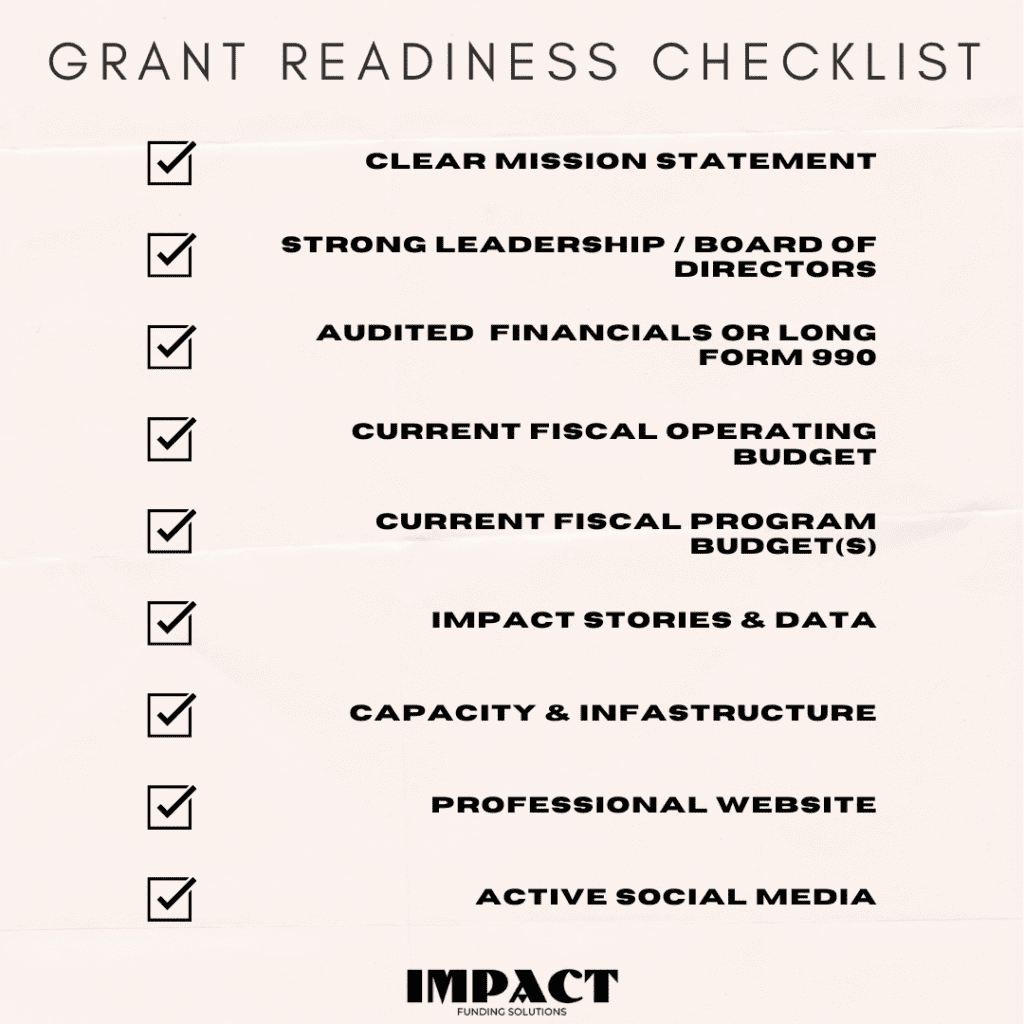
1. You Are a Legally Recognized Nonprofit
At minimum, most grant funders require:
• 501(c)(3) status (or a fiscal sponsor)
• An EIN
• A registered board of directors (with 3 to 5 members)
That’s it. You do not need to be operational for years to qualify.
2. You Have a Clear Mission and Programs
Grant funders want clarity, not complexity.
You should be able to clearly answer:
• What problem are you addressing?
• Who do you serve?
• What programs or services do you offer?
• Why does this matter in your community?
Even a single, well-defined program is enough to begin applying for grants. Pre-program? No problem – we would suggest launching a beta program to be able to show proof of concept and initial results – this will get you grant ready much faster. Funders lean heavily on impact numbers and results even if those are small at first.
3. You Have Basic Financial Documents
Grant readiness does not require audited financials for most local and regional grants. What is important is transparency.
At minimum, you should have:
• A current operating budget
• Program budgets (one per program)
• Basic financial statements (income and expenses)
• Filed tax returns or a plan to file them – in the US even if your nonprofit is under $50k in revenue we highly recommend filing the EZ long form 990 to strengthen the trust in your financials.
Clean, understandable numbers matter more than size.
4. You Can Show Impact (Even Early Impact)
Impact does not have to be complicated or data-heavy.
Examples of early impact include:
• Number of people served
• Programs delivered
• Sessions held
• Resources distributed
• Stories and testimonials
Grant funders understand that newer organizations are still building systems. They value intentional tracking, even if it’s simple.
5. You Have a Professional Online Presence
Your website and social media are often the first stop for grant reviewers.
You don’t need anything fancy, but you do need:
• A clear website with your mission and programs
• Contact information
• Basic credibility indicators (board, partners, photos)
• At least one active social media platform – but better to have Facebook and Instagram.
Your online presence helps funders trust that you are real, active, and accountable.
6. You Are Willing to Plan Ahead
Grant-ready nonprofits think in terms of systems, not one-off wins.
This includes:
• Applying for multiple grants each month
• Planning grant cycles 6–12 months ahead
• Tracking deadlines and reapplication timelines
• Completing post-grant reports and stewardship
Grant readiness is about consistency, not chasing random opportunities.
Can a New Nonprofit Apply for Grants?
Yes.
Absolutely yes.
Many funders:
• Support first-time applicants
• Prioritize emerging organizations
• Focus on local and grassroots impact
• Offer smaller, entry-level grants
Being new does not disqualify you. Being unprepared does.
How Long Does It Take to Become Grant-Ready?
For most nonprofits, grant readiness can be achieved in 30–90 days with the right guidance.
This often includes:
• Creating or cleaning up budgets
• Clarifying programs
• Organizing documents
• Building a grant calendar
• Strengthening online presence
Grant readiness is a process, not a label. And it gets stronger with time and impact!
Why Grant Readiness Matters
Grant-ready nonprofits:
• Miss fewer opportunities
• Apply more consistently
• Build stronger funder relationships
• Improve approval rates over time
• Create long-term funding stability
This is why we use the term grant management, not just grant writing.
Final Thought
If you are waiting to feel “ready enough” to apply for grants, you may already be ready.
Grant funders are not looking for perfect organizations.
They are looking for clear missions, responsible leadership, and thoughtful planning.
Grant readiness is about structure, strategy, and consistency.
And it can be built, step by step.
IF YOU NEED SUPPORT WITH YOUR GRANT MANAGEMENT STRATEGY CONTACT US FOR A FREE DISCOVERY CALL
Frequently Asked Questions
What does grant-ready mean for a nonprofit?
Grant-ready means a nonprofit has the basic organizational, financial, and program information needed to apply for grants responsibly and consistently.
Can a nonprofit apply for grants in its first year?
Yes. Many grants are open to new nonprofits, especially local, community, and corporate funders.
Do you need audited financials to apply for grants?
Not usually. Most grants accept internal financial statements or filed tax returns, especially for smaller and mid-size organizations.
RELATED BLOG POST: